1078 points by rbanffy 671 days ago | 301 comments on HN
| Mild positive Editorial · v3.7· 2026-02-28 11:46:32 0
Summary Science & International Cooperation Advocates
This ESA article on the James Webb Telescope's observations of the Horsehead Nebula demonstrates commitment to scientific freedom and international cooperation. The content supports multiple UDHR provisions through open publication of peer-reviewed findings, transparent scientific methodology, and freely accessible educational information. The international research collaboration and public dissemination of knowledge exemplify values of freedom of expression, thought, and participation in scientific culture.
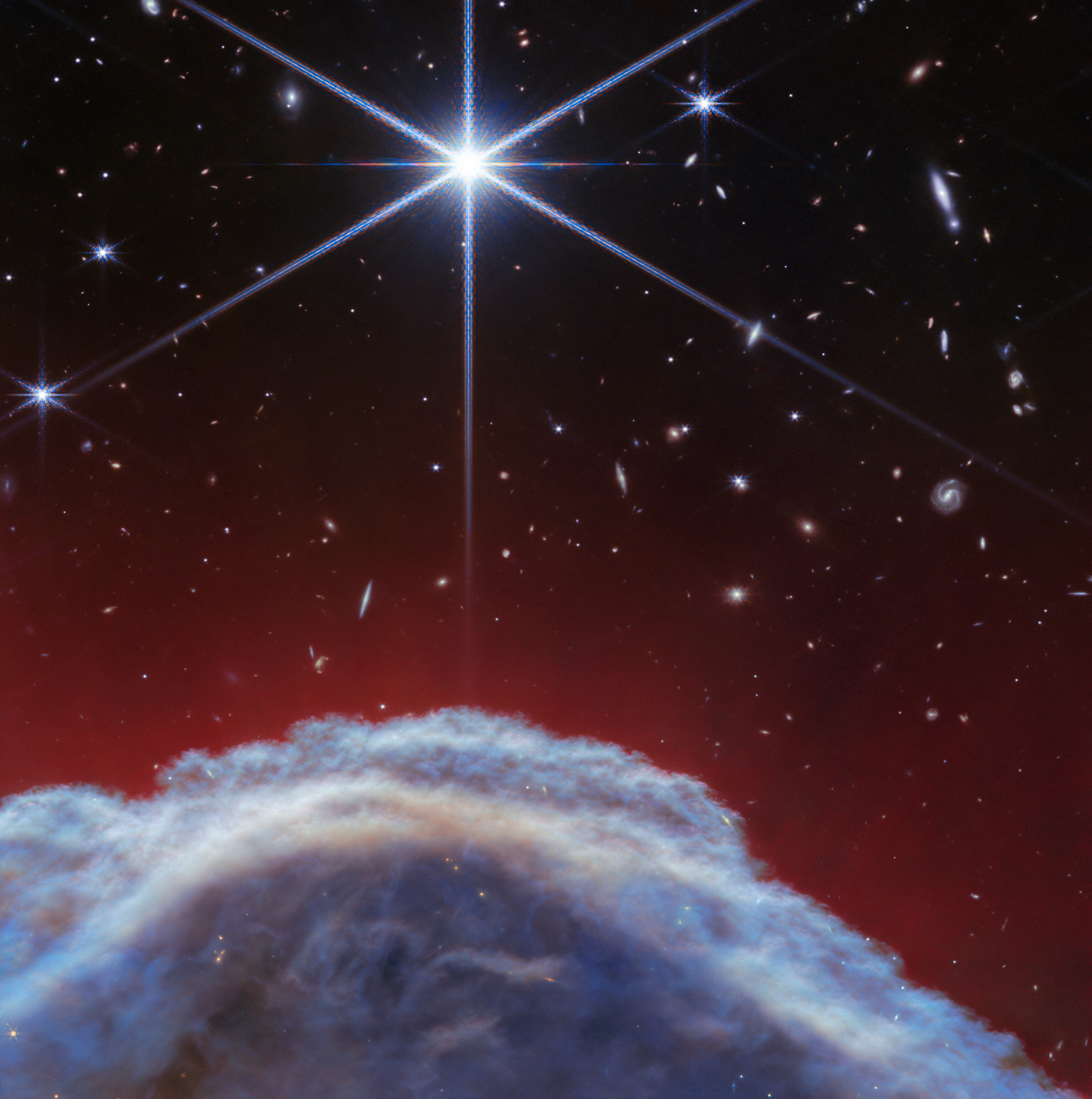
What is really, really neat to notice isn't just the detail in that final image.... look behind it, and there are whole edge-on spiral galaxies in the distance. Not stars. Galaxies.
The nebula is about 1375 light years away. Those galaxies in the distance.... are billions of light years away. It's hard to comprehend.
It's so very unlikely that there aren't millions of other lifeforms out there.
Sometimes I think that life could well have been just my soul and no one else, but here I am sharing this world with billions of other people, trillions of other lifeforms on this planet alone. So it is possible that more than one lifeform exists, that they share this universe and communicate in it. Why shouldn't this also be possible on millions of other earth-like planets out there?
Wow. The NIRCam image is probably going to be the most exciting new photo, but I can't get over how well MIRI reveals the internal structure of the nebula.
Gorgeous and upsetting that I'll never be able to visit it.
13 billion years before me, potentially trillions of years after me. Seems like such a waste of the spark of awareness that I can't take that awareness and experience the galaxy in all its glory.
Every single time I see one of these amazing space pics, it's hard not to get all philosophical and wonder about the size of space & time on cosmic scale, how small our earth is and how insignificant our regular problems are.
I don't care if I don't get to see flying cars or AGI in my lifetime but I will be very disappointed if our knowledge of space remains more or less the same as today without much progress.
For a sense of scale, the Horsehead Nebula has a diameter of 7 light years which is greater than the distance of 4 light years from us to Proxima Centauri.
For a size comparison, here's a stacked, partially star-tracked image I took fully shot at 85mm on a full frame camera to show the perspective. The vertical 3 bright stars to the center/left are the belt of Orion.
The small black notch in the red nebula to the bottom right of the belt is the horse head.
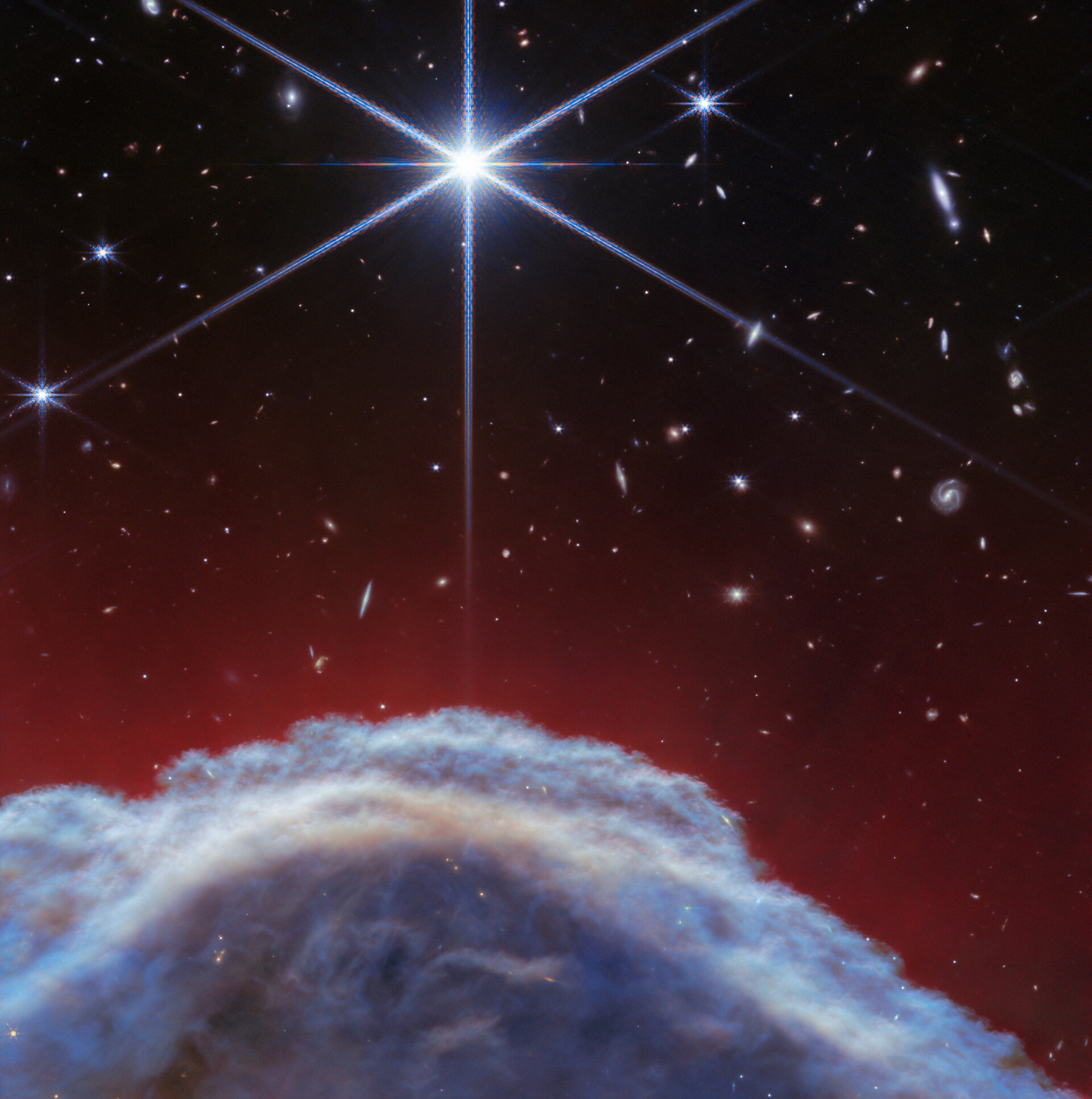
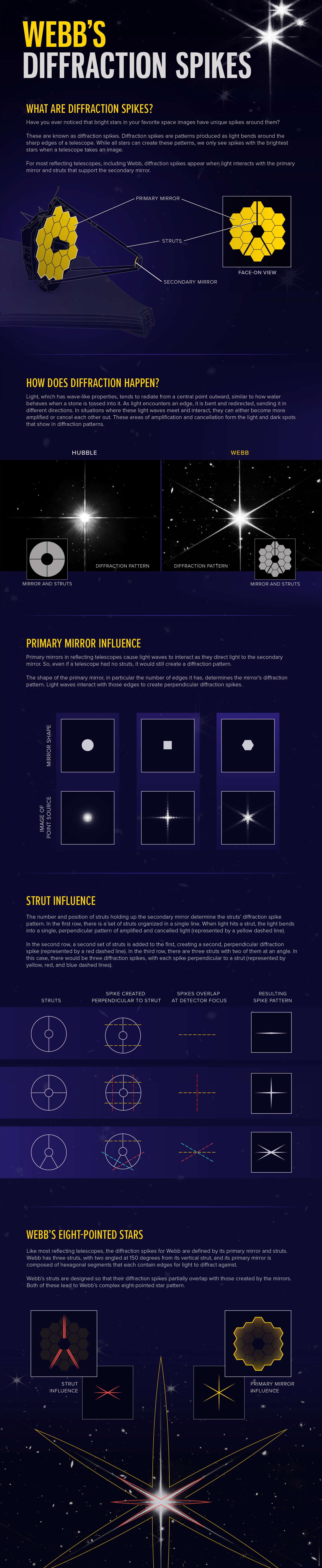
JWST optics makes quite unique diffraction spikes. Not only that there are eight of them, but on full resolution images [1] they have distinct pattern, as if made from separate dashed lines.
Are colors of those tiny lines (mostly red here - although this is false-color image) also diffraction artifacts, or do they correspond to actual spectrum of the stars causing them?
So the irony of these large cosmic structures is that if you were within them or in there proximity you wouldn't know. I mean you could see if you were in a nebula by the dust and gas you could detect in most or all directions. But you probably couldn't tell how that would look from 10,000 light years away.
But there's a distance where such structures would probably fill the night sky because you were close but not too close. Some of these structures aren't necessarily visible to the naked eye, even if close, but some are. I wonder what that would do if you were on a planet where the horsehead nebula (or something similar) filled the sky and its brightness rivalled the Moon.
Anyone else get the strangest sinking feeling in the final seconds when it's almost fully zoomed in and you come to the realization that the hundreds of specs in the distance are GALAXIES?
For a little bit of context for how impressive this is, here's my take on it with a consumer grade 8" Newtonian telescope from my backyard: https://www.astrobin.com/full/w4tjwt/0/
>Deep Sky is narrated by Michelle Williams telling the story about the production of the James Webb Space Telescope and its impact on the technological improvements it made upon the Hubble Space Telescope.[6]
I am reminded of David’s song in Psalm 19 … It’s amazing to me how in the thousands of years since he wrote these words, we’ve still only scratched the surface of observing the beauty and depth of creation.
The heavens declare the glory of God; the skies proclaim the work of his hands. Day after day they pour forth speech; night after night they reveal knowledge. They have no speech, they use no words; no sound is heard from them. Yet their voice goes out into all the earth, their words to the ends of the world.
What do you all think all this comes from? To me personally it always baffles me with wonder. I think of the analogy of a mouse living in a cage. Do they actually even realize they are inside a cage? Inside a world constructed by some other being?
What baffles me is that the explanation of reality is too complex for our brains to grasp. Same as to how the mouse will never be able to understand they live in a cage (or even the concept of a cage?) no matter the knowledge we throw at them.
Of course there are other lifeforms out there, it's statistically implausible for it to be otherwise. What's also implausible is that, given the impossible vastness and hostility of interstellar space, that any will ever manage to contact us, specifically. Fortunately, we've got lots of crazy lifeforms here on Earth to keep us occupied, if we can take a moment to stop extincting them as fast as we possibly can.
> look behind it, and there are whole edge-on spiral galaxies in the distance. Not stars. Galaxies.
just to add to the awe of that, pretty much every "dot" in one of these images is going to be another galaxy. individual stars from within the Milky Way will have diffraction spikes and very obvious as a single item.
> Seems like such a waste of the spark of awareness that I can't take that awareness and experience the galaxy in all its glory.
But you just did. That's what we're doing.
The horse head part that we see is 3x4 LY in size. If you wanted to experience that horse head like you would, say, a mountain -- just a large, field of view dominating visage. You would need to be about 20+ Lightyears away from it.
I don't know how bright the nebula is, but after 20 lightyears, I don't know how much the human eye could perceive it. And, likely, by the time you got close enough to actually see it, it may well just be a hazy cloud with no definition, since you'd be so close.
Things like these may only be able to be experienced by us through artificial means. Through embellishment and enhancement.
You can go and buy a "smart telescope" today that you can push a button, and point it at any of the "local" nebulas or other bright objects in the sky. Yet, if you look through the eyepiece, you won't see much. Even with magnification, it's a gray, fuzzy blob. The smart telescope will automatically capture more light, through longer exposures, and create a composite image with better definition and detail. Even with magnification, we can not experience those objects directly.
Astronomy, for me, is most "personal" with a pair of binoculars, particular a pair of stabilized binoculars. A mundane pair will open up the sky in a breathtaking way. Because it's more "real". It's not a picture on screen, and it wide and sweeping and huge.
But you can't really get those really fun Milky Way photos folks are making, not with binoculars. You CAN see the Milky Way under dark skies, but not like those photo capture them.
So, simply, "you can shut up. Stop typing now. Really", you may well have just experience the nebula as best as it can be done right now. Run that video on a huge TV in a dark room, it will help. Maybe see if any of this stuff is coming to an IMAX theater near you.
> it's hard not to get all philisophical and wonder about the size of space & time on cosmic scale
Indeed!
Never a bad time to re-watch Cosmos and (in my opinion) the awesome sequel(s) by Neil de Grasse Tyson. Is it weird to admit I even choke up during some of the episodes?
(As an aside, why is it so hard to find the sequels to Cosmos in any streaming service. In my country it's not on Netflix, Disney+, Apple, HBO/Max, Star+, Prime Video. What the hell...? I just want to re-watch the damned thing and I don't own a Blu-ray player. Do I have to pirate the stuff?)
How tiny are we (Humans, Earth, Solar system)... less than a speck of dust in the Sahara.
I used to look up in space when I was growing up and there wasn't any light pollution to the small town I was growing up in. At some point I think I started suffering from 'cosmic horror'. In later years I would pay attention only to the moon, and that reduced my stress significantly.
Nowadays (like in this bit of news, with photos) when I stick to the small photo in an article, I feel ok. When I see it in full size and I zoom in, and I realize that "sh*t! these 5-10-50 tiny white marks are GALAXIES.. and I have to change topics/tabs to keep the cosmic horror at bay.
>that they share this universe and communicate in it. Why shouldn't this also be possible on millions of other earth-like planets out there?
one trivial but powerful observation that von Neumann made was that our galaxy say, is actually pretty small. It's about 100k light years big, which means that any civilization spreading at only a tiny fraction of the speed of light could expand through the entire milky way in only a million years. We could very well spread through the entire galaxy in the near future if we manage to get to like, 1% of light speed in the next few hundred years.
So our galaxy, which contains a few hundred billion stars almost certainly has no other intelligent life in it for the simple reason that it'd be everywhere. That doesn't mean there's no microbial life or maybe technological life billions of light years out there but the fact that we're so alone in our neighborhood is a pretty strong indicator in the direction that advanced life might be much more rare than some people assume.
We are lucky that we live in a sweet-spot era where the universe is old enough that we have 13 billion years to look back on, but young enough that all the galaxies haven’t receded behind the cosmic horizon yet due to the accelerated expansion of the universe. In some billion years, intelligent beings will only have historic records, if anything at all, to look back to how the observable universe used to be filled with billions of galaxies.
We're probably not getting to space without AGI or at least some level of sophisticated AI. At a certain point our biological bodies are just wed to the Earth and its ecosystem, as we are animals that are products of the Earth.
If "we" ever get out there, some form of mechanical AI will. And we will never know it because once we send those ships off, we'll be long gone before the return signal gets to us from some far of locale. Imagine a voyager who can self-repair, mine asteroids, print circuits, etc. Now imagine giving it a 1 million year mission. Maybe by then we'll all have given up on biology and we'd be the "robots" on that ship.
Sometimes the universe makes beings like us, but not often, and probably makes all manner of interesting beings that will most likely be forever out of reach, and us out of their reach. Kudos to some life on a faraway planet, I wish we could meet.
Also its fun to think of the universe as a system. Here's this incomprehensibly large thing constantly in motion, constantly having stars die out and explode, and new ones born, etc all the time but to us at incredible slow speeds, everywhere, yet at incredible distances from each other. Its like this bellows that keeps a fire lit, over and over, non-stop. But not quite non-stop because this great furnace too will (probably) have a proper death. This universe life cycle chart is both a feat of science and an incredible work of a permanent and grim mortality of all things.
We don’t know how large the universe is, and how (un)likely life is. Life could very well be highly unlikely with respect to the size of the universe. We currently have no good way to tell. The only thing we know is that life is not impossible.
I found this mesmerizing. Particularly fun is to scrub forward and backward through the video to clarify where exactly you're looking. (I found it worked better on the embedded video in the article than the yt one, not sure why)
The 6+2 spikes around the bright stars is a diffraction pattern created by the edges of the hexagonal mirror segments (the six large spikes) and the three struts that hold the secondary mirror (also six spikes, but four overlap with the mirror spikes).
The color gradation is due to phasing effects from the different wavelengths of light being combined, and the checkerboard effect is an artifact of the segmented mirrors.
JWST has separate modes for spectroscopy. They’re pretty cool!
Why will there only be trillions of years after you? Why not quadrillions? Couldn't we just pick an arbitrary number up to the largest variety of infinity?
International scientific cooperation and peaceful advancement of human knowledge demonstrated through collaborative research project published for public benefit
FW Ratio: 50%
Observable Facts
Article documents international collaboration among NASA, ESA, and Canadian Space Agency on research project
Research results are publicly communicated and accepted for publication in peer-reviewed journal (Astronomy & Astrophysics)
Inferences
International scientific cooperation and public knowledge sharing exemplify commitment to peaceful advancement of human understanding
Open publication of research demonstrates institutional duty to share discoveries with global community
build 1ad9551+j7zs · deployed 2026-03-02 09:09 UTC · evaluated 2026-03-02 13:57:54 UTC
Support HN HRCB
Each evaluation uses real API credits. HN HRCB runs on donations — no ads, no paywalls.
If you find it useful, please consider helping keep it running.